Breaking It In
The most common complaint about a new hat arrives on the fourth day, and the most common mistake is giving up on it on the fifth.
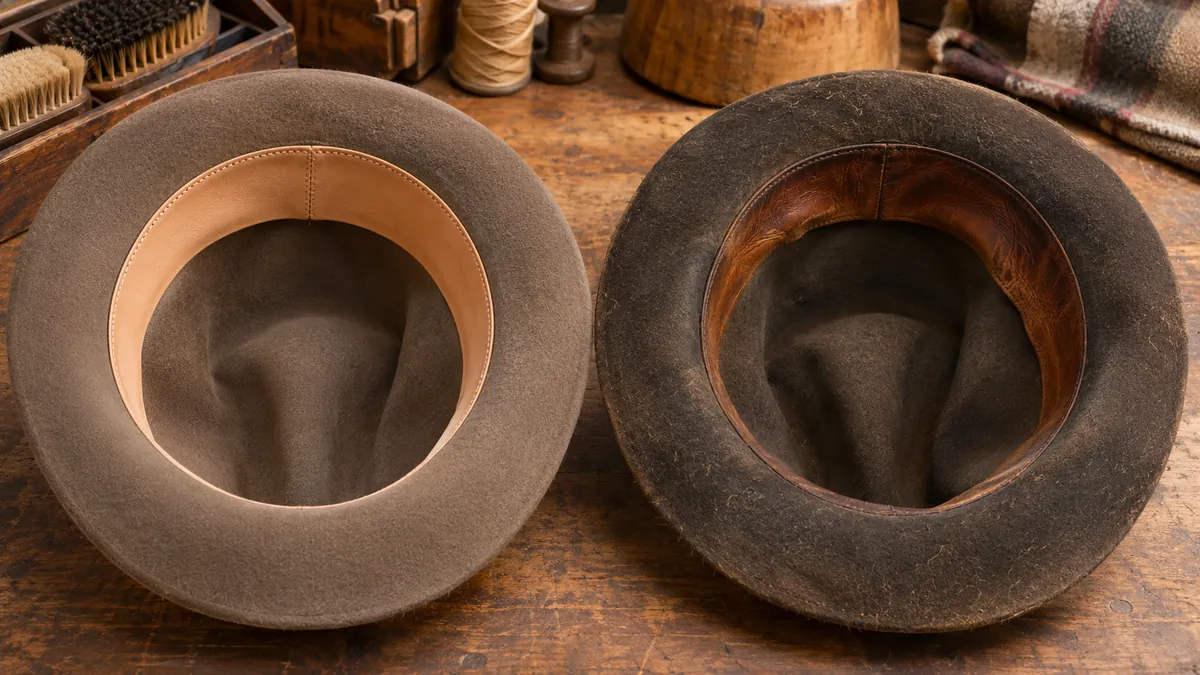
At the bench
A fresh leather sweatband is firm. It has been cut, skived at the edges and stitched into the crown, but it has never been warmed by a head or bent by a long afternoon outdoors. For the first couple of weeks it presses in places, it squeaks a little when the hat goes on, and it leaves a faint line across the brow.
Then, without anyone deciding the day, it gives. The leather warms, takes on a slight curve that matches the wearer's forehead and settles. Owners who wait for that moment usually end up with the hat they reach for every morning for years. Owners who come back on day five asking for a larger size often end up with a hat that slides down over their ears a month later, once the leather has done what it was always going to do.
We tell everyone the same thing at the counter: give it three weeks of ordinary wear before judging the fit. Not one long wear on a hot Saturday, but a little every day. Short, regular contact is what teaches the band its shape.
Under the band
New habits meant to keep a head clear follow the same path, and they get abandoned at the same point. The first week of a fresh routine almost always feels awkward. The new bedtime feels early and the mind will not settle. The phone left in another room keeps tugging at attention. The crossword after lunch seems slow and a little silly. Day four arrives, nothing seems different yet, and the routine goes back in the drawer.
What we would stitch inside the band is a promise to wait out the stiff stretch. Pick one change, not five, and wear it a little every day for three weeks before deciding whether it fits. A habit adopted on Monday and judged on Friday has not had time to take any shape at all.
A few things from the workshop make the wait easier. Keep the change small enough that it can survive a bad day; a ten-minute version kept daily beats an hour-long version kept twice. Tie it to something already fixed, the way our band is tied to the crown. Morning coffee, the evening news, the walk to the mailbox: any of these can carry a new habit on its back. And use the notebook from the first notch to mark each day you kept it, so the three weeks are counted honestly instead of guessed.
Readers sometimes ask what the softening feels like, so they know whether it is coming. In our experience it is quiet. One day the routine simply stops requiring a decision. You reach the hour and do it, the same way you reach for the hat by the door without thinking about the fit. That is the sign the leather has taken.
And if, after three honest weeks, the habit still pinches in the same place, it may simply be the wrong size for your life. Swap it for another and start the count again. That is not failure; it is a fitting.
One caution we give at the counter applies here too. Do not try to rush the leather by soaking it or forcing it over a stretcher on day two; it tends to crack. A routine pushed too hard in the first week tends to crack the same way, so let the small daily dose do its slow work.
A tag sewn in for the doctor
Some changes to sleep, mood or concentration are not habits to wait out. If something new has come on quickly, if it is getting steadily worse rather than easing, or if it is getting in the way of work, driving or looking after yourself, do not give it three weeks. Call a physician and say plainly what has changed.