Sunday Dressing
Leather does not ask for much. It asks for the same little bit, on the same day, for as long as you want to keep it.
At the bench
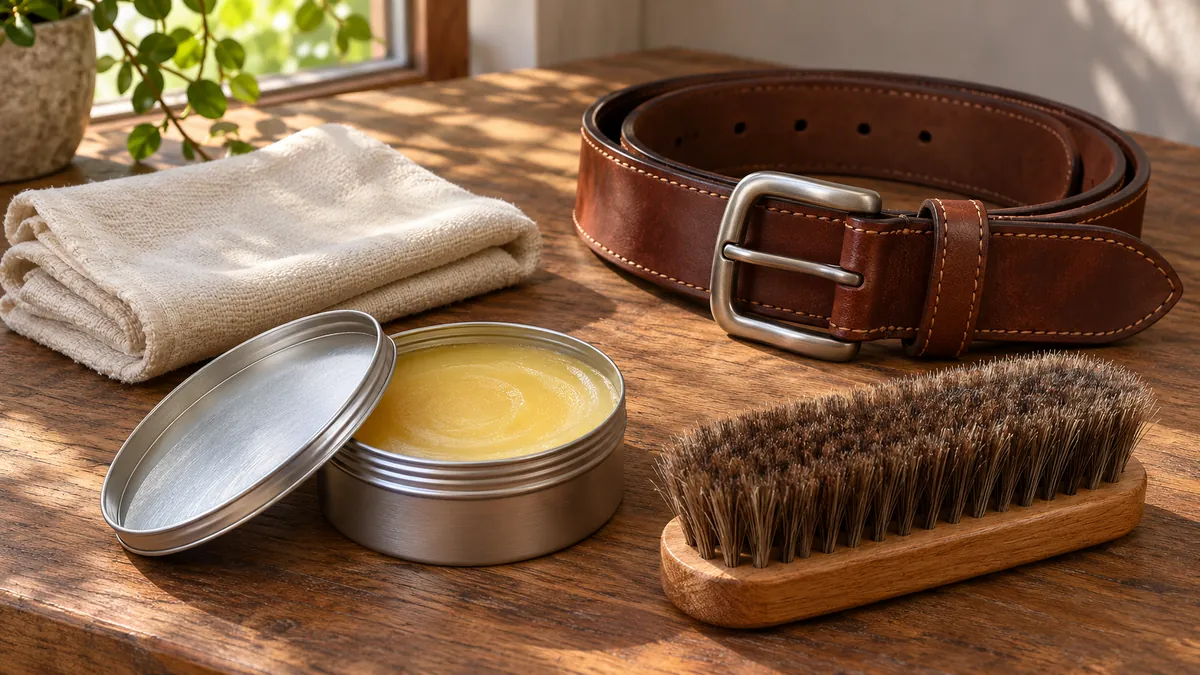
Customers often ask what to do so a leather hat or belt lasts. The answer disappoints people who were hoping for a secret product. Once a week, wipe the dust off with a dry cloth. Once a month, work a thin layer of dressing into the leather with your fingers or a soft rag, let it sit, and buff away what did not soak in. Keep it out of the hot car. That is nearly all of it.
What makes the difference is not the dressing. It is the regularity. Leather that gets a few minutes of attention every week stays supple and shows small problems early: a seam starting to lift, a patch drying out near the brim, a stain that will come out if it is caught now. Leather that is ignored for a year and then rescued in a single afternoon rarely recovers the same way. In the shop we keep the habit ourselves. Sunday evening, the week's hats on the table, the cloth, the tin, and nobody in a hurry.
Under the band
The note we would stitch here is about giving the week the same treatment. Choose one fixed hour, on one fixed day, to look over the days ahead and tidy the loose ends of the days behind. Sunday works for many people. Any day works if it never moves.
Sit down with the calendar, the notebook from the first notch and something to write with. Go through the coming week slowly. Which appointments need something brought along? Whose birthday falls on Thursday? Which bill comes due? Write each of those on a single list that will live somewhere you see every day. Then look back at the week that ended: anything promised and not done, any name you meant to look up, any call you meant to return.
People who keep a weekly hour like this tend to describe the days that follow as calmer rather than busier. Part of the reason is simple. When the week is laid out on paper, the mind no longer has to carry it all at once, and it is freer to pay attention to whatever is right in front of it. Much of the daily feeling of forgetting is really the feeling of trying to hold too many small things in the head without a place to set them down.
Two rules make the hour last. Keep it short enough that it never feels like a burden; thirty to sixty minutes is plenty for most households. And protect it the way you would protect a standing appointment with a friend. If something pushes it aside, do it the next morning rather than skipping the week, because a missed week is the start of a missed month.
A tin of leather dressing lasts years in our shop, because each Sunday uses only a little. A weekly hour works the same way. The cost of any one session is small. The value is in the line of Sundays behind it.
If a household has two people, consider sharing the hour. Reading the week aloud to each other catches the appointment one person forgot and the other remembered, and it turns a chore into a short, steady conversation. Several customers who began doing this tell us the Sunday talk ended up being the part of the week they guard most closely.
A tag sewn in for the doctor
A weekly hour can organize a full calendar. It cannot explain why appointments that used to be easy to keep are now being missed, or why the list no longer seems to help. If that is the pattern you see, mention it to a physician, and bring a few weeks of lists along so the conversation starts from facts.