The Peg by the Door
In our workshop, an empty hook is information. It tells you which tool is out, and usually who has it.
At the bench
A leather workshop runs on small, sharp tools: round knives, edge bevelers, awls, stitching chisels, the creaser, the mallet. They are easy to set down and hard to find again among scraps of hide. So the oldest rule on any bench we know is that every tool has one hook on the wall, and it goes back on that hook the moment the job is done.
The rule sounds fussy until you work under it. Nobody spends the afternoon hunting. A new apprentice learns where everything lives in a day, by reading the wall. And an empty hook becomes a quiet signal; you notice it the way you notice a missing tooth, without having to think about it. The tools are not easier to remember. The wall does the remembering for you.
Under the band
Most of the misplacing people complain about at home is not a memory problem in any deep sense. It is a placement problem. Keys get dropped wherever the hands were when the door closed. Glasses end up on the arm of a chair, the bathroom sink, the car seat. The mind was busy with something else in that moment, which is normal, and later it has nothing to go on.
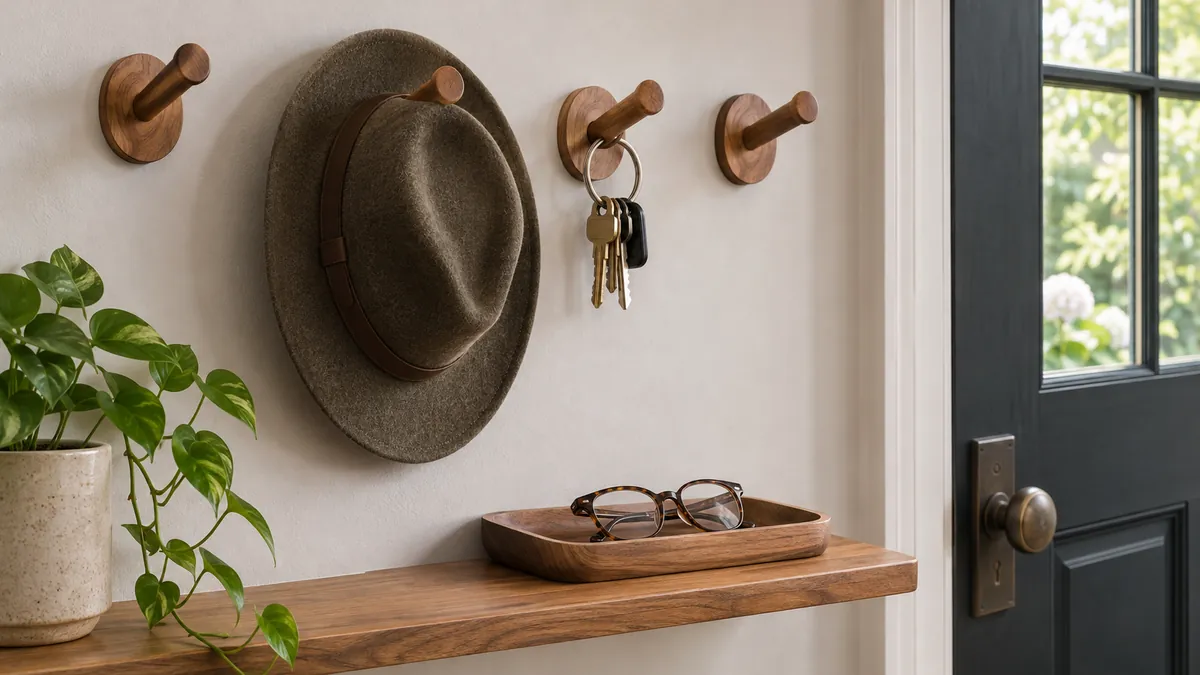
The note we would sew inside the hat is to give the objects that travel one home each, as close to the door as possible. A row of pegs or hooks for the hat, the jacket, the keys and the bag. A small tray on a shelf for the wallet, the phone and the glasses you wear out. A charger that lives right there, so the phone has a reason to land in the same spot. Then keep the one rule of the workshop wall: the thing goes back the moment you walk in, before you sit down, before you check the mail.
It takes a couple of weeks to stick, much like the stiff band in the second notch. During that stretch, it helps to say the action quietly as you do it. "Keys on the peg." It feels a little silly. It also turns an automatic gesture into a noticed one, which is exactly what the mind needs to file it.
The same idea spreads usefully through the house. A single basket for the bills, a single drawer for the batteries and the flashlight, one spot on the counter for the medicine schedule. Every fixed place you create is one less thing to keep in your head, and one less small search that can sour a morning. Readers who set up a wall like this often say the biggest change is not that they lose fewer things. It is that they stop feeling, several times a day, that their memory has let them down.
Our pegs at the shop are plain dowels in a pine board. They have held the same tools for years. Yours can be anything, so long as each one has a single job and never a second.
A last practical point. Put the pegs where your hands are already full on the way in, not where the house looks tidiest. In our shop the hooks sit at elbow height beside the cutting table, because that is where a finished tool is held. At home the right spot is usually a step inside the door, on the side of the hand that carries the keys.
A tag sewn in for the doctor
Fixed places help with the ordinary kind of misplacing. They will not help if objects keep turning up in odd spots you cannot account for, if familiar routes start to feel confusing, or if people around you are worried. Those are reasons to see a physician soon, and to bring someone along to the visit if you can.